About
A Heritage Space for Contemporary Art
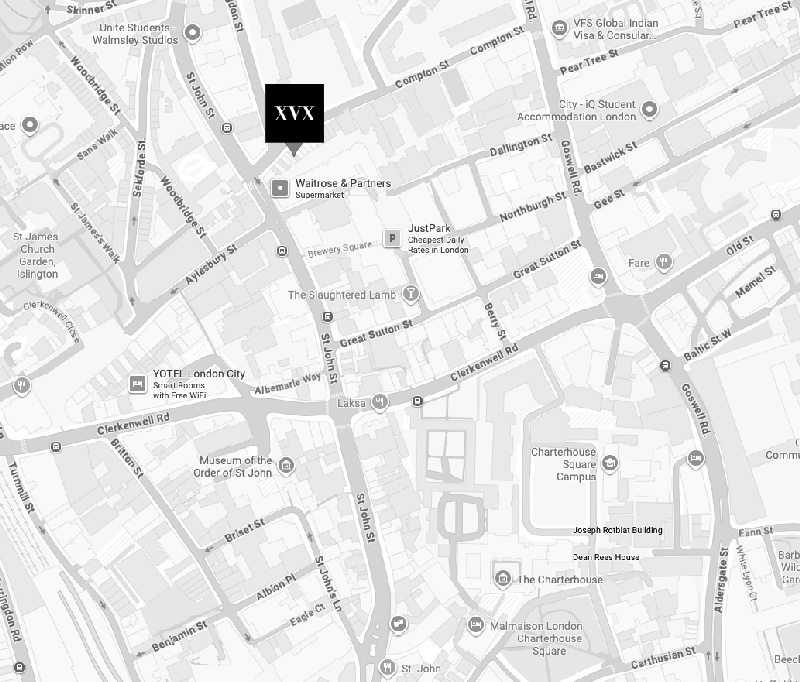
Map
About
Established in 2025, XVX is a contemporary art platform developed through collaboration between artists, curators, collectors, and cultural professionals internationally. The organisation operates from its permanent exhibition space at 72 Compton Street, London EC1V 0BN, a Grade II-listed Georgian townhouse built in 1796 and located within the Clerkenwell Green Conservation Area—an area historically associated with London’s mercantile, craft, and intellectual life.
XVX functions both visually and conceptually. X marks a point of crossing—an encounter, collision, and exchange. V suggests emergence and openness. X—V—X forms a symmetrical structure: crossing, emergence, and crossing again. The name reflects the organisation’s commitment to dialogue across histories, geographies, and artistic languages.
Artist Jian Jun Xi (JJ Xi) has long engaged with historical architecture as a site of cultural memory. At XVX, a structure carrying more than two centuries of London’s urban history becomes a setting for contemporary artistic discourse. The building has been carefully restored to preserve its architectural character while supporting a forward-looking exhibition and research programme. This approach reflects broader heritage principles articulated by Historic England: respecting historical integrity while allowing living culture to evolve within historic structures.
Within the walls of a house built in 1796, the organisation stages artistic conversations that address the urgencies of the present. Its programme focuses on artists whose practices engage with memory, displacement, authorship, and the material histories of art. Particular attention is given to forms of cultural production that remain outside dominant narratives: unfinished plans, rejected proposals, concealed traces, private letters and photographs, and actions performed without an audience. Through exhibitions, research, and public programmes, XVX seeks to recontextualise cultural narratives within historic urban environments—concerns that are deeply connected to the founders’ own trajectories.
ABOUT THE BUILDING
72 Compton Street, a Grade II listed building, forms part of a modest late Georgian and early Victorian terraced house that characterises much of Clerkenwell’s historic urban fabric. The building has recently opened as a contemporary art space.
Historical Timeline
AD 43 (Roman Period) – Early routes developed north of Roman London, including roads that later formed part of the droving routes leading towards Smithfield
Medieval Period -The area north of the City remained largely agricultural, with Bunhill associated with burial grounds
1686 – A lease of Woods Close was granted to William Pym for a period of 62 years, permitting speculative development across the estate
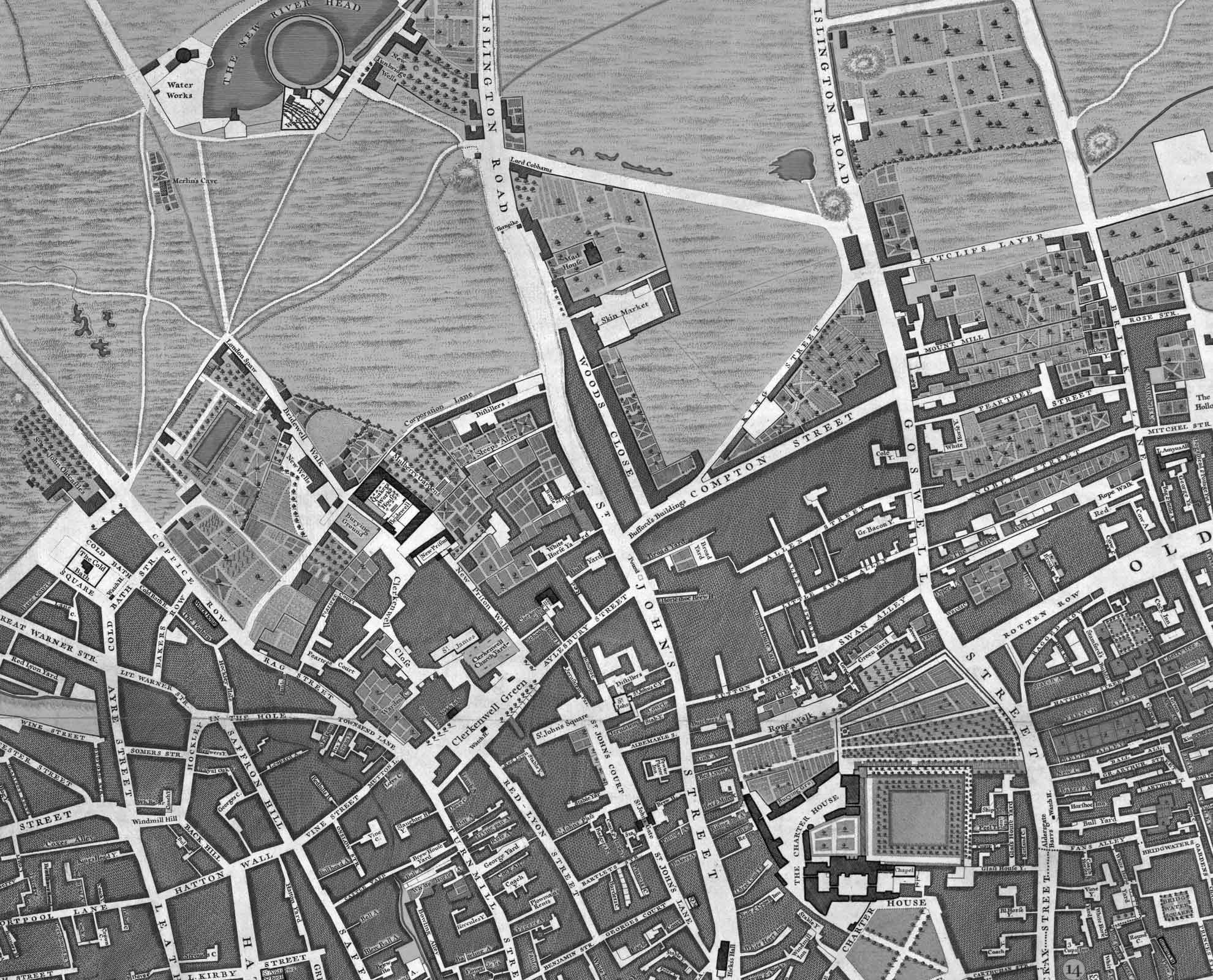
1720 – Building plots along Compton Street were enclosed in preparation for construction, as illustrated on historic maps such as those by Richard Blome
1746 – Mapping evidence indicates that the street pattern, including Compton Street, had become clearly established
1796 – Nos. 72–77 Compton Street were built as part of the terrace frontage
Early to mid-19th century – Compton Street became fully urbanised. Characterised by terraced housing and small commercial premises
Late 19th century (c.1870) – Clerkenwell developed into a dense urban district, with industrial uses including distilleries and workshops typical of Clerkenwell
1898 – A stone plaque reading “Rufford’s Buildings 1688” was discovered on a house at the western end of the street, commemorating an Islington bricklayer Nicholas Rufford, who built several houses here between 1685 and 1688
Early to mid-20th century – Buildings continued to be used for mixed residential and commercial purposes, although local manufacturing industries gradually declined
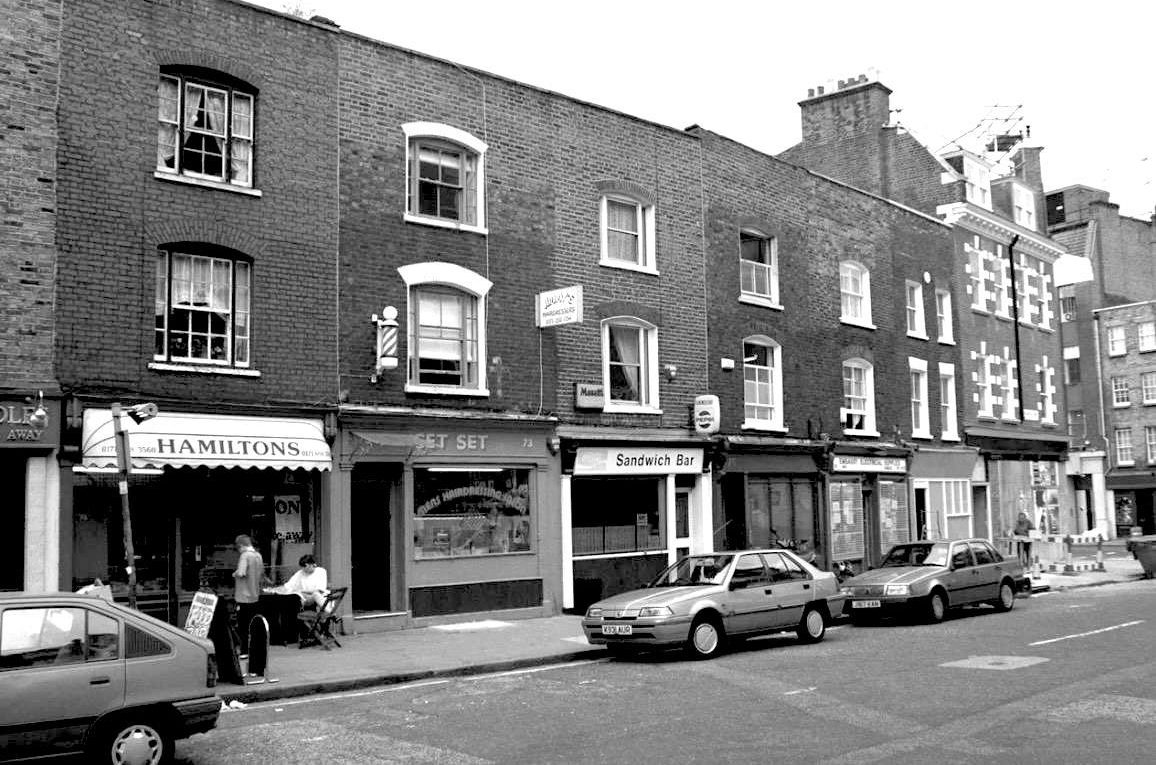
1977 – Angela’s Hair Fashion began operating at the property 1985-1986 – Hamiltons Coffee occupied part of the building
Late 20th century – Clerkenwell experienced significant regeneration, with creative industries, design studios, and office uses replacing traditional industrial activity
21st century – Historic buildings such as Nos. 72–77 Compton Street remain integral to the character and heritage value of the area
2026 – XVX Art Space opens within the restored Georgian townhouse at no.72, introducing a contemporary cultural use within the historic building, designed as a meeting point for heritage, contemporary art and cross-cultural exchange
Timeline of
Compton Street
Roman Period (after AD 43)
Early routes developed to the north of the Roman city of London, including roads that later formed part of the droving routes leading towards Smithfield.
Medieval Period
Land to the north of the City remained largely agricultural. The Bunhill area became associated with burial grounds located outside the city walls.
16th Century
The area became known as Woods Close and formed part of the Northampton Estate.
1686
A lease of Woods Close was granted to William Pym for a period of 62 years, permitting speculative development across the estate.
1720
Building plots along Compton Street were enclosed in preparation for construction, as illustrated on historic maps such as those by Richard Blome.
1746
Mapping evidence indicates that the street pattern, including Compton Street, had become clearly established.
Late 18th Century (1791)
A survey of Woods Close was undertaken to manage estate development and infrastructure, including the New River Company’s water mains.
1796
Nos. 72–77 Compton Street were constructed as part of the terrace development forming the street frontage.
Early–Mid 19th Century
Compton Street became fully urbanised, characterised by terraced housing and small commercial premises.
Late 19th Century (c.1870)
The surrounding area developed into a dense urban district, with industrial uses including distilleries and workshops typical of Clerkenwell.
1898
A stone plaque reading “Rufford’s Buildings 1688” was discovered on a house at the western end of the street. It commemorates Nicholas Rufford,an Islington bricklayer who built several houses here between 1685 and 1688, contributing to the street’s early development.
Early–Mid 20th Century
Buildings continued to be used for mixed residential and commercial purposes, although local manufacturing industries gradually declined.
Late 20th Century
Clerkenwell experienced significant regeneration, with creative industries, design studios, and office uses replacing traditional industrial activity.
21st Century
Historic buildings such as Nos. 72–77 Compton Street remain integral to the character and heritage value of the area.
1977
Angela’s Hair Fashions operated from the premises.
1986
Hamiltons Coffee occupied part of the building.
2026
XVX Art Space opens, introducing a new contemporary cultural use within the historic building.